

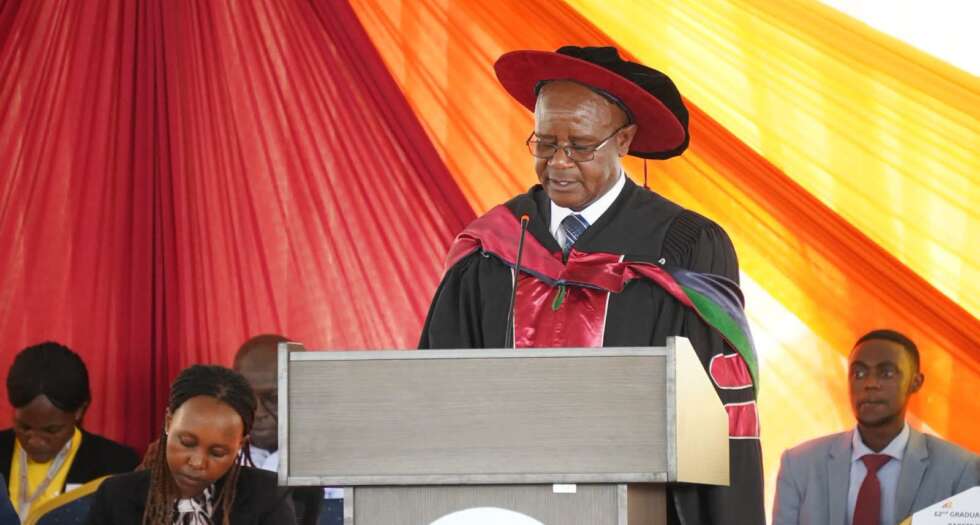
The July morning air in Nairobi carries a familiar, crisp chill, but inside the gates of the Railway Training Institute in South B, the atmosphere on Thursday, July 9, 2026, was thick with warmth and anticipation. The campus grounds came alive with a distinguished gathering, anchored by the Chief Guest, Principal Secretary for Transport, Mr. Mohamed Daghar, alongside the Kenya Railways Board of Directors, led by Chairman Mr. Abdi Bare Duale, and the Managing Director, Mr. Philip J. Mainga. They were joined by the Railway Training Institute Board of Governors, led by Chairperson Ms. Mercy Cherongis, and the host of the day, Director of the Railway Training Institute, CHRP Asava Kadima. Standing before them was a proud assembly of graduates, their emotional parents, and the dedicated academic team, all gathered to witness a profound milestone of shared achievement and institutional pride.
This occasion was far more than an annual academic send-off, as the institute simultaneously marked its historic seventieth anniversary alongside celebrating the sixty second graduation ceremony. It represented a beautiful convergence of history, anchoring seven decades of excellence in railway training for the future. As one thousand one hundred and thirty five young men and women adjusted their mortarboards, they were stepping into a legacy that traces its roots back to 1956 when the institute first opened its doors to build the human resource capacity for the region, and even further back to 1896 when the very first railway lines began carving their way through the Kenyan landscape.
Long before the formal processions began and the heavy brass music signaled the arrival of the dignitaries, the campus grounds transformed into a living museum of tomorrow. The traditional tents and neatly arranged chairs stood adjacent to a sprawling exhibition of pure engineering grit. Here, the graduating class did not just display poster boards; they showcased the tangible fruits of their late nights in the workshops, proving how seventy years of hands-on heritage has evolved into modern technical mastery.
The delegation of guests walked through an impressive gauntlet of student innovation. There were functioning mechanical hydraulic systems operating with precise fluid dynamics, and intricately assembled petrol engine training kits designed by the engineering students to serve as teaching tools for the generations coming after them. Alongside these industrial marvels, students from the hospitality department brilliantly showcased their culinary skills, presenting a sophisticated array of gourmet displays and hospitality arts that demonstrated the institute’s diverse talent in service excellence. Scaled structural models of civil engineering projects further demonstrated how these young minds plan to tackle modern track alignments and complex drainage systems across East Africa. It was a powerful, silent declaration that these graduates were leaving the institute not just with theories in their heads, but with a profound, practical command of their respective crafts.
When the crowd finally settled and the speeches began, a clear harmony of leadership and vision resonated from the podium, respecting the very hierarchy that drives the nation’s transport sector. Taking the stage to deliver the keynote address, the Chief Guest, Principal Secretary Mr. Mohamed Daghar, emphasized the government’s alignment with technical empowerment, noting that the strength of the economy depends heavily on the quality of the workforce and that these graduates represent the vital engine required to fulfill the Bottom-Up Economic Transformation Agenda.
Following the ministry’s charge, Kenya Railways Board Chairman Mr. Abdi Bare Duale took the microphone to contextualize this milestone within the broader infrastructure landscape, observing that the transport and logistics sectors are expanding rapidly and that between the revitalization of the metre gauge railway, the steady expansion of the standard gauge railway, and growing blue economy projects, these specialized skills have never been more actively in demand.
Adding to this institutional directive, Kenya Railways Managing Director Mr. Philip Mainga spoke directly to the operational future awaiting the cohort, reminding the graduates that they are entering the industry at a spectacular time of transition and technological advancement, and urging them to maintain the highest standards of safety, precision, and efficiency that have defined Kenya Railways for generations.
Bringing the focus to institutional governance, RTI Board of Governors Chairperson Ms. Mercy Cherongis looked out at the sea of expectant faces and reminded them that technical brilliance is hollow without the steady anchor of discipline and professional ethics. She spoke of resilience, noting that the world waiting for them outside the campus gates is fast, unforgiving, and deeply in need of integrity.
Finally, it was the words of the host, Director CHRP Asava Kadima, that seemed to linger longest in the afternoon air. He reminded the cohort that their hard earned certificates were not mere pieces of paper to be framed and hung on a wall. Instead, he described them as quiet contracts of trust between the graduates and the society that so desperately needs their labor and vision. He spoke to them not just as a director, but as a guardian passing on a flame that has burned brightly since 1956.
As the afternoon sun softened over Nairobi, casting long shadows across the neatly manicured lawns, the official conferring of diplomas began. Each name read aloud was a celebration of years of sacrifice, of long commutes, of grueling exam weeks, and of collective dreams realized. When the final names were called and the collective roar of celebration went up, hundreds of caps soared into the sky.
They walked out of the gates that evening no longer as students bound by timetables, but as the new custodians of a seventy-year legacy. They are the technicians, the engineers, the hospitality professionals, and the visionaries who will keep the region moving, proving that while the tracks provide the path, it is the human spirit that drives the journey forward.